
One thing that has confused me since the start of the pandemic is why the stock market hasn’t crashed.
With unemployment soaring and GDP declining, stocks haven’t moved much. After a deep dive in March, the S&P 500 recovered some, and is now down about 12% year to date. Down significantly, but nowhere near the hit to employment and GDP.
Some might think that’s because the market expects a “V” shaped recovery, but I think it is more that the market doesn’t expect that most big companies will suffer from the pandemic. Based on looking at the top 100 stocks by market cap in the United States, you can quickly see why.
To start, many of today’s most valuable companies do not generate their value from physical assets. The top 100 companies include tech companies driven by software or specialty hardware, pharma companies that create value from patent, and consumer companies that depend on their billion dollar brands. Many of them can do fine in a stay-at-home economy. Even under lockdown and the subsequent recession, people still need their iPhone, their blood pressure medication, and their laundry detergent.
Stock performance reflects that. The chart below has the top 100 companies by market cap, organized roughly by industry. You can see quickly what is going on.
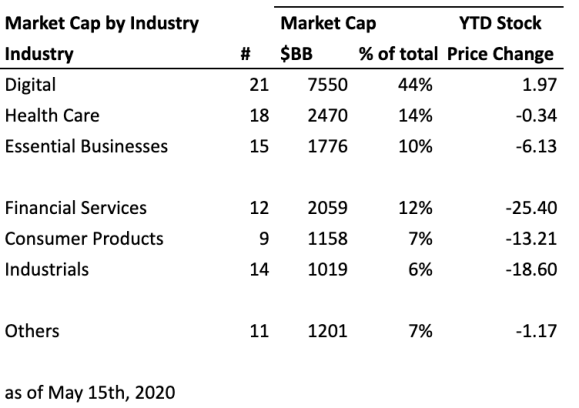
Digital businesses: the 21 tech companies like Amazon, Apple, Intel, and Oracle – are largely insulated from the pandemic. In some cases, like Microsoft, they are actually benefiting as demand for cloud services and digital games soar. This group’s stocks are up 2% since the beginning of the year. The impact of digital is disproportionate to the market, as they encompass 44% of the combined market cap of the top 100.
Health care businesses: the 18 pharma and health insurance companies – are also pretty pandemic proof, and not surprisingly, they too are basically flat – with big winners based on potential COVID treatments offsetting any losers like medical device manufacturers that may lose out on elective procedures.
Essential businesses: the 15 telecommunications firms, utilities, and essential retailers like Walmart and Costco, are also only down 6% since the beginning of the year. Again this is not surprising. Wireless, electricity, and groceries are likely the last things people will give up, so as long as stimulus checks find their way to consumers, these businesses will also be just fine.
Those “pandemic proof” categories are nearly 70% of the combined value of the top 100 market cap companies. Sure, a tough recession will hurt Facebook and Google’s ad sales, and people might delay an Apple Watch purchase or a knee replacement, but the positive drivers of increased digital activity, RX usage, and essential purchasing can offset the damage.
In the meantime, categories in the top 100 that we would expect to take a hit from the recession are down, sometimes significantly. Consumer product companies – while normally pretty recession proof – are down 13%. Industrials down 19%. And financial services are down 25%.
But these big household name companies, whether they be Proctor and Gamble, General Electric, or Wells Fargo, are simply not where the market cap is and have less impact on the overall market.
Many have noted this trend in the past, but a look at the numbers now is breathtaking.
Microsoft is worth about as much as P&G, Pepsi, Coke, Nike, Mondelez, Altria, Estee Lauder, and Colgate – COMBINED! Apple is worth as much as 14 large industrial giants.
And these are the largest companies in those categories – winners in a winner take all economy. Winners, but not super winners like the tech companies.
There’s plenty one can quibble with about this analysis – for instance the top 100 snapshot by definition is post the big pandemic stock moves. Full disclosure – I’m not a financial advisor or even a particular good investor. I’m not even sure if this condition is permanent. So certainly don’t make trading decisions on this!
But I am an educated observer, and the reality seems pretty clear to me. The big realignment of value creation around big tech companies and others with strong IP positions just got a lot more dramatic.
Moreover, value creation in the equity markets is divorced from the job market. The service economy that drives the labor market has been crushed. But for the most part, equity markets have less exposure to those categories.
This further bifurcation of the economy into a few big winners and a lot of small losers creates two big problems.
First, people need jobs – and the destruction of livelihoods and small businesses is catastrophic to millions of families. Moreover, the service economy of restaurants, retail, and tourism also generates taxes – both from payroll and sales taxes. The lost tax revenue is causing a huge crisis for governments at all levels.
The bifurcated economy will have profound implications for policy makers. If value is being created at the top of the economy and Wall Street thrives, while the rest country struggles, it is likely the resentment against big business and the tech companies will grow dramatically.
The money for all this stimulus needs to come from somewhere, and governments will inevitably look at big companies and capital gains to find it – if for no other reason, there’s no other place to go.
Meanwhile, it is hard to imagine there won’t be an even more aggressive push for some quarters to reign in big companies with a much tougher stance on regulation and antitrust.
 The Great Refactoring