Categories
Public Spaces

Pause Indoor Dining

As COVID again sweeps across the country, it makes little sense to discuss broad based restrictions while leaving restaurant dining rooms open.

As everyone from Dr. Fauci to Dick Cheney knows, wearing a mask is the best way to reduce the spread of COVID.  It is low cost, mildly inconvenient, and saves lives.  Even indoor activities (like shopping or taking mass transit) can function with limited risk, when you wear a mask.  

Except you can’t wear a mask while you are eating, which is why indoor dining seems to be a really bad idea. 

Data supports that intuition.  A detailed analysis of mobility data recently pre-published in Nature, shows that indoor dining was by far the largest driver of COVID spread in major metros early in the pandemic.  Writers say that reducing capacity can help reduce transmission, but still is a high risk activity.  

The tradeoff does not make sense when we are debating other measures like closing schools or more widespread lockdowns that have vast societal and economic costs.  

Experts have suspected the risks of indoor dining for a while. 

This summer, Drexel University noted anecdotal evidence that cities which opened indoor dining started seeing spikes in COVID spread 2-4 weeks after opening.  

At the end of June, JP Morgan showed a statistically significant correlation between restaurant spending and COVID spread.

On September 30th, NYC started indoor dining.  Rolling 7-day average positivity rate in New York on October 9th was 1.52% – slightly down after NY rolled out its microtargeting.  Positivity rate in New York City has nearly doubled in 5 weeks. 

Correlation is not causality.  And shutting down dining rooms won’t solve stop COVID’s spread alone. Colder weather, Halloween, and post election celebrations are also probably having an impact.

But when the mechanism is clear, the data is sound, and real world anecdotal evidence consistent, it is tough to see why we are continuing to leave restaurant dining rooms open.  The discontinuity is especially surprising in New York, where data driven decision making that has made the state a model for COVID management since the spring. 

While policymakers debate indoor dining, NYC public schools will need to go back to all remote learning if positivity rates go above 3%.  Given that evidence has shown schools, especially at the elementary level, don’t seem to drive high levels of COVID spread, the tradeoff doesn’t make sense.   

The only way to justify leaving restaurant dining rooms open is economic -to protect the millions of jobs dependent on restaurants. Outdoor dining helped, but not enough to offset the losses. Going into the winter, that alone won’t be enough to keep restaurants afloat. However, it isn’t even clear restaurants cane make it on reduced capacity anyway.

In addition, some will say that a restaurant dining room shut down government would be signalling out one industry unfairly over others.  That’s true.  The pandemic is unfair – many industries are booming during the pandemic, others (those that rely on physical space) are struggling.  

The better answer, as proposed by others, is for the government to make restaurants whole financially for keeping their dining rooms closed.  Restaurants do roughly $75BB in business every month in the US. 

Even if we paid them to keep dining rooms closed (and given revenue take out and outdoor dining, the number is likely less than the $75BB/month) for 4 months, the cost would be a small fraction of the pandemic’s overall economic impact.  The payments could insist that restaurant owners use some of the proceeds to pay furloughed employees.

The data is pretty clear on indoor dining, and policymakers ought to act now – both on shutting dining rooms and getting restaurant owners the financial support they need.

Categories
Business Models

Breaking: News is a good business

The reports of the death of the news business have been greatly exaggerated.

In fact, the COVID pandemic has helped demonstrate which news business models will succeed in the coming years. It has separated winners and losers with ruthless efficiency.  

Think about all the successful news businesses this summer.

  1. Subscription NewsThe New York Times now has 5.7mm digital subscriptions, generationing more than $500mm in annualized digital revenue.  Similarly, Dow Jones passed 2mm digital subscribers to the Wall Street Journal.  While COVID hurt ad revenues, the long term outlook for premium news products are strong, as digital subscriptions create a long term, durable recurring revenue model that scales, as incremental costs are minimal.  
  2. Cable News. The number one TV network in America this past summer?  Fox News. Fox News beat all the broadcast networks and all the cable networks, even with the return of sports.  While the pandemic and the election drove ratings for news networks, the dual revenue model delivered by cable retrans fees and advertising makes cable news networks valuable businesses.  
  3. Local TV News.  Station groups, which run significant local news organizations, continue to be attractive businesses.  Leading independent station group, Nexstar threw off nearly $300mm in free cash flow in a COVID depressed second quarter.  While many stations are privately held, or buried in media conglomerates, they continue to be cash machines.  Again, retrans fees, largely due to local news and sports, when added to local and political advertising, make TV stations a solid business.
  4. Documentary Filmmaking: Netflix, Hulu, Amazon, HBO, Showtime, and PBS are all making significant investments in documentaries – both feature length and series. Streaming services are booming, and original documentaries are a cost effective way for them to differentiate themselves. 
  5. Podcasting.  The media day is expanding, as audio news eats up time that can’t be spent on screens.  There are now more than 750,000 podcasts, with podcasting advertising forecast to top $800mm in 2020, despite having growth slow by the pandemic.   

COVID is generating a massive amount of news to cover, and an audience that needs to understand it with plenty of time on its hands.

In terms of impact, mobile video has dramatically changed how we hold the authorities to account.  Videos of police brutality have captured the attention of Americans, hopefully leading to meaningful criminal justice reforms.  As many have written, the news media’s coverage of Jim Crow in the 1960s helped garner broad based support for the Civil Rights movement.  

While the big companies with quality content are succeeding, there are opportunities for independent voices as well.  New distribution mechanisms are making it possible for anyone with an internet connection, a microphone, and a camera, to compete as a journalist.  

So why is the outlook for journalism so grim?  The answer is the dying newspaper business.  Pew reports that newspapers employed 71K newsroom personnel in 2008.  Newspaper newsrooms are down to 35K people in 2019, and likely even lower during the pandemic.  Other newsrooms have grown from 43K to 53K, but the net result is 25K fewer journalists in the past 10 years. That’s a lot on percentage basis, especially since so many of those folks are, by nature, loud.  

Moreover, making a living as an independent blogger or podcaster is hard – when you try to cover the news. On the flip side, if you are a good Tik Tok dancer, Instagram personal trainer, or Twitch video gamer – you can make bank on the web as an independent influencer.

Newspapers are dying for a simple reason – they have been unbundled.  Historically, news had a monopoly on distribution of classified and retail advertising. When combined with subscription fees, the newspaper was a cash machine. The internet took away the ad dollars – vertical specialists like Zillow, Indeed, and Autotrader took away classifieds, while retail advertisers migrated to Google, Facebook, and now Amazon. 

In the meantime, consumers stopped reading the print paper. They still want news, but not on paper 24 hours late, and not on a website that replicates the newspaper. They want TV, or a podcast, or perhaps from a high end subscription service.

Private equity swooped in and harvested what’s left.  In trying to maintain high margins, they defunded the newsroom and created an inferior product. Subscribers and readers moved on, and mid-sized papers went into the death spiral. COVID undoubtedly will accelerate this trend, and the debt piled on these assets will likely make them even shakier.

The loss of newspapers is felt at the local level. There is plenty of coverage of Washington D.C. Major metros like New York get covered both by general interest newspapers and specialist verticals like Politico for politics and Chalkbeat for education. There are plenty of new voices being heard on digital platforms from Instagram, to Twitter, to YouTube, to TikTok.  

But mid-sized and small towns are becoming news deserts, as reported by UNC.  More than 2000 newspapers have disappeared in the last 15 years.  Half of US counties only have one newspaper (usually a weekly). Pure play digital sites, especially in smaller regions, have struggles.  And the quality of “news” content on social media ranges from extraordinary to thought provoking to silly to mundane to flawed to in some cases, dangerous.

Back when I was in college, the alumni of my college paper would come in and talk about the golden age of news and how the industry was in decline.  That was in the mid 1990s.  I suspect there were similar conversations in other eras. Journalists are often a grumpy bunch. It is tough to get a job in newspapers now.  

But we’re making a mistake getting hung up on national news.  Sure, publishers that chased clicks on social media to support an ad model have struggled. COVID has proven that arbitraging Facebook and Youtube traffic is simply not a sustainable strategy. Still, society can easily survive the loss of many click farms and the death of traditional media titles that ruined their brands in the name of cheap traffic and ad dollars. 

There are plenty of examples of national news organizations making money.  Those that have bet on a high quality product, supported by dual revenue stream business models (subscriptions/ retrans fees and ads), are doing best. A healthy NY Times, Wall Street Journal, and Washington Post, and not to mention strong subscription titles like the Atlantic, the Economist, the New Yorker should do a fine job holding the federal government accountable.

We would all be better suited honing in on the problem of local news – which is the big problem right now, and acknowledge that national news creation has arguably never been better in terms of breadth, depth, and scope. News deserts are destined to get worse, allowing local governments to run without much accountability.

Innovative non profits like the Texas Tribune have come up with an interesting model. Without the profit motive, institutions can reinvest all their proceeds into news coverage. This might be particularly well suited to local news, which is tough to support – especially for important, non-clicky content about school textbooks, budget debates, and underserved communities.

Getting that content to a broad audience remains a challenge.  The more insidious problem is distribution (what gets read or viewed by whom on what platform), but that’s for another blog post.

Categories
Public Spaces

How cities can bounce back

Digital disruption finally made it to the physical world.

The COVID-19 pandemic accelerated the trend to the digitization of public spaces. But it didn’t play out the way we all expected. The big digital platforms did to physical spaces what they did to every other business – transferred activity and value from the real world to the digital world. 

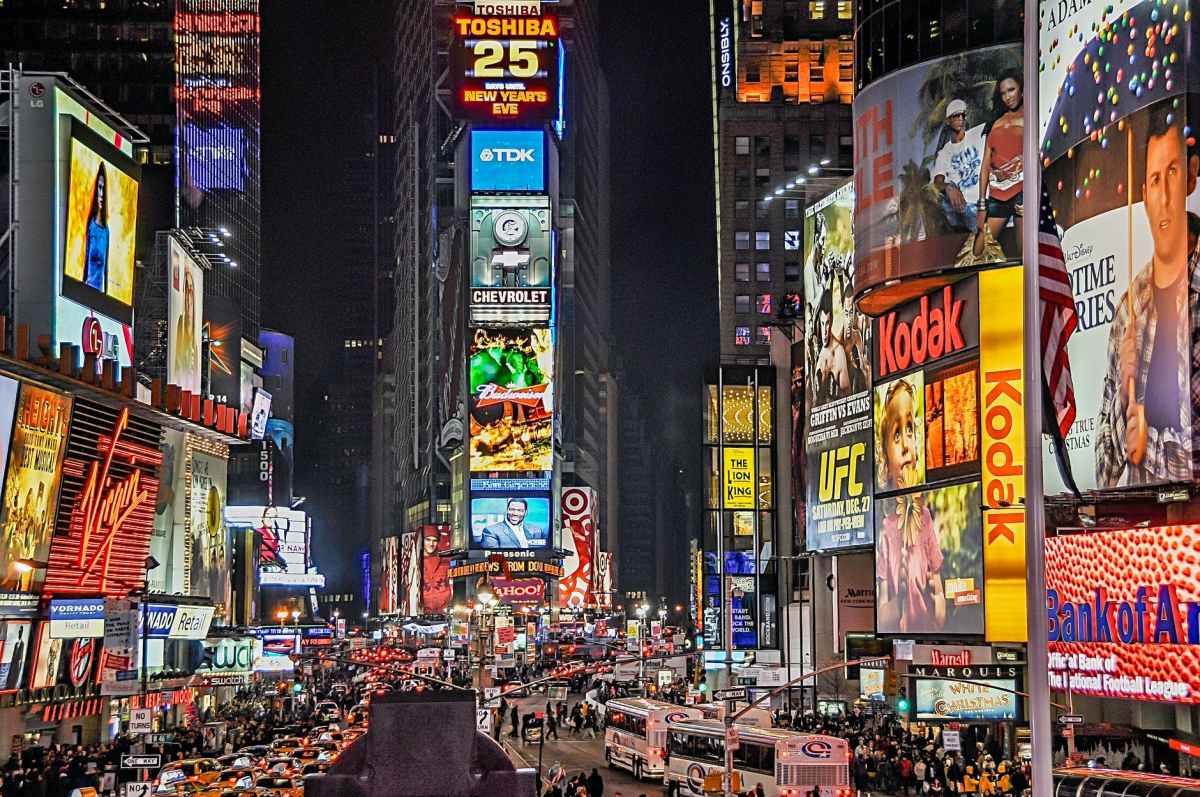
As the economy gets going again, downtowns are still empty, and Times Square is still quiet (down 83% year over year in July). I personally do not believe the apocalyptic view that cities like New York will never be the same. People have been betting against New York City for 200+ years, and those who do get their heads handed to them. 

But it won’t come easy. Twenty years of digital disruption reached Main Street. The pandemic sparked a massive shift in consumer behavior which erodes many advantages cities have had for centuries. While the pandemic will eventually end – perhaps as early as the first part of next year, many of the changes to consumer behavior are likely permanent.

To thrive in the long term, cities need to start planning for a post-COVID world now – with a focus on being desirable and affordable places to live – even if people no longer need to be there for their jobs.

Think about how daily life in America has been refactored since March 11th – the day the NBA shut down, Tom Hanks got coronavirus, and Americans recognized the scale of the crisis.  

  1. Work. In June, more than 40% of Americans were working from home, accounting for two thirds of economic activity.  With many companies keeping their offices at least partially shut for the foreseeable future, it is unlikely that we are ever going back to a world where masses of people are coming into the office five days a week. The 1.5mm commuters coming to Manhattan every day – as represented in this incredible map – is probably a lot lower going forward.  
  1. RetailOnline shopping went from 11% to 16% in Q2.  Amazon had a monster quarter, while Target and Walmart showed huge growth in their online channels.  The 16% number is even bigger when you consider that restaurants, car dealerships, and gas stations account for 40% of retail sales. Given that drug stores and supermarkets account for another 20%, a large portion of the goods and services that are well suited to online purchasing are now being purchased online.  
  1. Entertainment. Streaming services, online gaming, and Zoom chats soared during the pandemic.  Netflix added 26mm subscribers in the first half of 2020. People everywhere survived not going to restaurants, concerts, and sporting events for six months and that blackout on live events will last another six months.
  1. Education and Health Care. The last frontiers of digitization – health care and education also got a shock. Schools everywhere moved online while telemedicine finally took hold. 

While the real world economy struggled – damage was limited to small businesses and companies directly tied to public spaces – like travel, tourism, “non-essential” retail, and theaters. Unemployment was still north of 8% in August and over 20% in leisure and hospitality.

But other parts of the economy did fine. Stocks did well despite the crisis, as investors recognized that the pandemic actually drove growth for the big digital companies and essential industries already winning in the economy.

The internet stepped in and replaced many activities historically reserved for public spaces. Work from home, e-commerce, streaming, e-health and online education were happening before COVID. But the crisis made the transition go much faster and more decisively.

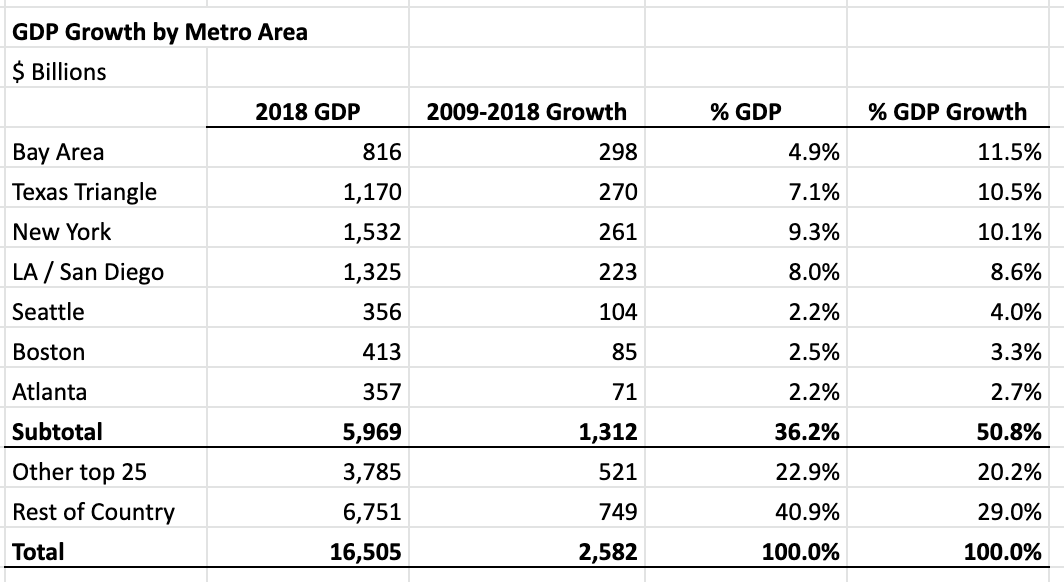
This is a big change for cities. Historically, people and businesses paid a premium to be close to economic activity. Long before the internet, network effects were driving economic growth in many great cities as industries clustered together. Superstar cities were collecting most of the economic growth.  Between 2009 and 2018, seven regions (New York, LA, the Bay Area, the Texas Triangle, Boston, Atlanta, and Seattle) accounted for half of U.S. GDP growth.   

Cities had a virtual monopoly on great jobs, and bundled a set of activities around the jobs.  Live, work, shop, and play – all in one place, in walking or subway distance from where one lives. The “urban bundle” had a huge benefits to consumers – and helped drive a rebirth of cities.

If you don’t need to go into work every day, that benefit gets eroded. Now, you can pick the best place to live – period – with less regard to where you work. You can accept a longer commute if you have to do it less frequently. You can substitute an infrequent weekend visit to living in the city to get your live event fix. The “urban bundle” is less valuable – you pick locations as you need them.

Newspapers learned the hard way how brutal the unbundling process can be. They were cash machines when they were the only way to distribute retail and classified advertising to the home. When the internet unbundled news from ads and classifieds, newspapers were crushed. Only brands that could create content good enough that people were willing to pay for it, like the New York Times or the Wall Street Journal, could thrive.

Now cities face a similar set of challenges. The default of moving to New York to work in finance or San Francisco to work in tech is likely over. Consumers survived months without going shopping on Michigan Avenue or Rodeo Drive. Cities no longer have a monopoly on great jobs, the best shopping, the most sophisticated entertainment, or even the most influential education and health care institutions.   

So how can cities bounce back?  Ideally, by being affordable and desirable places to live. That means local governments need to cater to residents who live in cities not because they need to, but because they want to.

Everything starts with affordability – which means affordable housing and good public schools. It is beyond the scope of this article to tackle public education – other than to note that it is critical.  

With regards to housing, it is likely most cities need to adjust their affordable housing strategies. Pre-COVID models of high end apartments with 20% reserved for affordable housing won’t work in the coming years. There’s already plenty of vacancies on the high end, and it will take years to burn off the excess supply. In the meantime, long time residents struggle to find homes. 

It will be crucial to figure out a business model that creates 100% affordable developments. That may require relying more on non-profit developers in the near term and reinvesting in existing stock rather than the high end until the market rebalances – which could take many years. Community land trusts and co-ops may be a place to invest stimulus dollars to take real estate off the market and make more housing units permanently affordable.

From there, cities will need to think like the companies disrupted by the internet as they plot their comeback.  Successful cities will double down on six unique advantages that the internet can’t take away.

  1. Walkability. Even when working from home, a walkable local neighborhood remains highly desirable. Outdoor dining, one of the few bright spots for cities in the pandemic, became a way for neighborhoods to maintain vibrant street life. Combining independent restaurants with bakeries, places of worship, independent retailers, coffee shops, beauty parlors, barber shops, and gyms, make a walkable neighborhood a great place to live and an even better place to work from home. In addition, small co-working spaces where people can “work from home” from outside their apartment may become the new go-to amenity for buildings or neighborhoods.
  1. Independent businesses. Unique walkable neighborhoods rely on small businesses. Lacking the scale to compete online, many of these small businesses are deeply at risk.  Yelp reports that more than 175K businesses closed since the pandemic started, with nearly half of those closures permanent. The damage was worst in cities like LA, San Francisco, Chicago, and New York.  Entrepreneurs will restart businesses, but cities need to make it easier and eliminate red tape.  SF Mayor London Breed’s focus on streamlining the permitting and approval process is a good example of what cities need to do. More direct support will likely be required, as getting small businesses back on track has to be a top priority. Independent businesses create jobs, improve quality of life, and allow residents to build wealth.
  1. Parks and waterfront. Park usage in big cities has soared during the pandemic – for good reason. People needed to get out of their apartments. The need for quality public outdoor space will continue post pandemic, especially in a more work from home economy. It will be tempting for cities to pull back on their parks to save money, but few city amenities have more impact on more people at lower cost than a good local park or playground. Major landowners may have to help subsidize those efforts, like the Central Park Conservancy does in New York. 
  1. Leisure and live events.  Once the pandemic is over, there will be massive pent up demand for experiences, so live music, theater, comedy clubs, restaurants, museums, and gaming spaces will do well once the pandemic ends. Cities still have critical mass to remain experiential destinations, which will have enduring appeal to tourists, singles, and empty nesters.
  1. Cultural institutions. Similarly, museums, public gardens, symphonies, operas, and other cultural institutions remain a critical advantage cities have – and governments and the real estate owners need to keep these institutions afloat. Not only do they support tourism and quality of life for residents, but cultural institutions are a strategic advantage for urban public schools – which often benefit from outreach and educational programs.  
  1. Diversity. Finally, cities have the critical mass to support a great deal of diversity – of ethnicity, faith, education, and interest. Long before Facebook Groups, people could find the group they were looking for in a city. More importantly, in physical space citizens also benefit from meeting people who they don’t seek out. Maintaining that diversity requires ensuring equitable growth policies for all neighborhoods and populations.

Much of these advantages come back to the power of individual neighborhoods. Residents and small businesses will become a bigger portion of the city economy, making affordability and livability across all neighborhoods in a city more critical than ever.  

Like companies undergoing digital disruption, cities can survive and even thrive, if they focus on their residents and the unique advantages the internet cannot take away. People have always and likely will always want to congregate in cities. But why and how they come together will change, and the cities that innovate for that new reality will be the most successful ones.

Categories
Public Spaces

A better use for parking spaces?

Social distancing is making the streets a lot more crowded.

What started as a lifeline for urban restaurants may prompt a rethink of how best to use the streets as cities like New York trade parking spaces for dining tables.  

With indoor dining still banned in New York City because of the risks of COVID transmission, city officials let restaurants build out temporary structures for diners over the parking spaces.

It really was a lifeline for struggling restaurants, which could not make ends meet on takeout alone. The city made an effort to balance public health and the economy, while creating sanity for citizens desperate to socialize in a responsible fashion.

New York has always had robust sidewalk dining.  Walk through the Village or Columbus Avenue on the Upper West Side and you’d always see tables on the side walks. The street level expansion complemented the original sidewalk cafes, creating room for many more socially distanced tables.  

Now, the semi-permanent structures are popping up all over the city.  The Mayor’s Office says nearly 10,000 restaurants have applied for the program and 80,000 workers are benefiting from the outdoor dining program.  The program has been so successful, it will extend into next summer, regardless of the pandemic’s outcome.    

To put those numbers into perspective, about ~170,000 New Yorkers work in the City’s 27,000 restaurants.  So, while outdoor dining hasn’t solved all the restaurant’s industry’s challenges, and doesn’t provide a solution when the City gets cold come November, it provides an important opportunity to a significant fraction of the industry.   

The reason for the success – besides customers needing their neighborhood restaurant fix after being stuck in the apartment for months – is that outdoor dining was always the better experience anyway.  Folks usually preferred the outdoor tables on the sidewalks, as it was a better experience than being in a tiny restaurant.  

The trend is not limited to New York.  Philadelphia, Chicago, San Francisco, and other major eating hubs have taken a similar approach – testing street closures to let restaurants move outside. 

Yet again, COVID has prompted a rethink of how businesses work, especially in public space. It also has prompted a rethink of how to value the streets themselves.

Many have pointed out that free street parking is a subsidy to drivers, at the expense of pedestrians and bikers. Some estimate the value of street parking in New York at $500/month

As a public good, giving that space to restaurants – which generate tax revenue, jobs, and a vibrant street life that helps property values and safety, feels like an even better deal.  

The big fight to come will be what happens at the end of the pandemic, when cars demand their streets back. Even in less car friendly locations like New York, huge portions of the City’s real estate gets devoted to automobiles. 

The need for an overall redesign of how cities use their streets has been long overdue. Restaurants will join bikes, scooters, delivery trucks, EV charging stations, and transit authorities as competitors for valuable street real estate. Again, the pandemic sharpens a debate that has been brewing for a while.

But for now, dining out will help a lot of workers (and probably some New Yorkers) get through an otherwise bleak summer and fall.

Categories
Public Spaces

The most important COVID stat

We’re swarmed with coronavirus data – everything including new case counts, disease projections, positive tests, and hospital utilization. 

But in the end, only one number matters, and that is Rt – the current reproductive rate.  In other words, the number of people each person with the disease infects.  Public health, the economy, and the speed of recovery really tie to whether the number of infected people is growing or shrinking.

The basics are pretty simple.  If Rt = 1, each person infected with COVID will infect one other person.  If Rt < 1, each person infected with COVID infects less than 1 person (in other words 100 people with COVID might only infect 50, if Rt = 0.5).  If Rt > 1, each person with COVID infects more than one person.

If Rt < 1, the disease eventually fades away.  If Rt > 1, the disease will continue to expand, potentially uncontrollable.  If Rt hovers around 1, we’ll stay at status quo.  

That’s why anyone paying attention should be concerned with New Jersey’s recent revelation that Rt is now at 1.35.  Even New Jersey, which for several weeks had COVID largely under control, risks seeing increasing cases. With Rt above 1, those increases will start to compound, and the pandemic will get worse. 

If you’re running a business depending on physical assets or public space, and you want to have a read on the future, Rt is really the number to watch.  Even if cases are low, if Rt > 1, the disease will start to spread faster. 

Forget the unemployment claims number or GDP – the economy is driven by the pandemic, and the best way to measure the pandemic’s trajectory is Rt. One would think CNBC would be reporting Rt every morning.  It would not surprise me if some smart quant trader has built it into a model somewhere.

While the media has covered R, the coverage seems less than Rt’s importance warrants.  Instagram founders Kevin Systrom and Mike Krieger have created a site, rt.live, to track this on a state by state basis.  

While a lot of a disease’s transmission rates is tied to the biology, Rt is somewhat controllable.  If everyone wears masks, Rt goes down.  If people social distance, Rt goes down.  If asymptomatic people with COVID hang out in bars or house parties without masks, Rt goes up.  

When you look at rt.live on August 1, the data is mediocre.  Few states are significantly below 1, and several are above 1.1. 

The good news is the Rt of 2 or 3 that many states were seeing in March are well past.  Even states with haphazard reopenings stayed below 1.5 during May and June and now as they take better precautions and the disease has started to run its course, Rt is back down near 1.  

However being at 1 with a high number of daily new cases isn’t great either – it just means the plateau will be higher.  So now, as a country, many states have thousands of new cases a day with limited prospects of seeing the numbers go down.  

Despite early challenges, New York handled its shutdown and reopening well.  It drove Rt down to 0.7, vastly reducing the disease’s spread. Then it reopened slowly, keeping bars and indoor dining closed in New York City.  The net result is is low cases, Rt hovering slightly under 1, and at least outdoor activities open.  

The tragedy is if policymakers in other states were watching Rt more closely, they may have tailored the reopening strategies (i.e., masks, limited indoor dining) to keep Rt near 1, thus avoiding their subsequent spikes.  Perhaps, then we all wouldn’t be fretting over whether we can safely open our schools.

Why Rt isn’t the first number everyone is reporting baffles me.  Maybe it is too hard to understand. But the bottom line is that until Rt goes significantly below 1 for a long period of time, COVID will not go away.  

Even a vaccine won’t make COVID go away.  It only helps drive down Rt due to more people being immune, which eventually reduces or eliminates the disease.   

There is a country that is managing their COVID response explicitly by Rt, Germany.  As early as April, Angela Merkel explained the concept succinctly.  Not surprising, given the data and science based approach she has taken from the beginning – and Germany’s relatively effective handling of the pandemic.

Categories
Uncategorized

Why Stocks Still Haven’t Tanked

On May 18th, I posted “Why Stocks Haven’t Tanked.”

At that point the S&P 500 was only down 12% YTD – which was surprising, given the terrible economy.  I wrote that the big reason was that big companies really weren’t suffering that much – especially when you consider the performance of the major digital businesses that drive most of the equity markets.

Well, since then, the S&P is now only down 2.2% YTD.  As we approach the second quarter earnings season, I decided to redo the analysis.  As you can see, the story hasn’t changed – in fact concentration on the digital winners got even bigger.

Screen Shot 2020-07-12 at 5.51.36 PM

In the top 100 US stocks, digital businesses surged – now up 34% YTD.  

Nearly half of the market cap of the top 100 US businesses are in digital businesses.  In addition, Tesla – a car manufacturer that investors see as “digital” is up a whopping 268% YTD.  I made Tesla its own category since it was warping the analysis.     

When you take into account the 24% of the top 100 market cap in health care and essential industries (like telecom or big box retail), nearly three quarters of the largest portion of the stock market is relatively pandemic resistant.

The rest of the stock market, the industrial, consumer, financial services, and other companies are also off their lows, but still down year over year.  More importantly, they are making up a smaller and smaller piece of the overall market.  And for the most part, they too won’t see much impact from the pandemic.  Even banks, which might lose money on loan losses, will get bailed out from the government.  

No doubt the pandemic is hitting certain sectors extremely hard, like retail, restaurants, bars, cruise ships, and airlines.  Restaurants, bars, and retailers are often small businesses and don’t really affect the market.  There are some travel companies, but they are a tiny component.

Earnings may change this outlook, as ad supported digital companies Facebook and Alphabet will likely have rough second quarter reports.  Moreover, it is possible that the market is overvaluing the digital revolution on an absolute level, even though it is performing appropriately on a relative level.   

In either case, the implications for the real world economy are pretty troubling.  New virus surges in the Sun Belt will slow or reverse reopening.  Small businesses with physical assets like restaurants, bars, and recreational facilities will stay closed or operate way below capacity.  Small business operators will continue to be crushed while major companies will get stronger.  

The problem is that 30 million people work in retail trade, leisure, and hospitality.  Those industries are going to be crippled for months, so it is hard not to see near double digit unemployment going on for a while — not to mention the knock on effects as many companies simply stop hiring due to the uncertainty.  Moreover, sales taxes will continue to be shrunk, hurting local and state governments.

With “pandemic economics” likely lasting through next year, the value consolidation will likely get even more pronounced.  

The combination of digital employees and shareholders getting richer, millions of unemployed low wage workers, and governments running huge deficits is a recipe for extreme political backlash.


Categories
Uncategorized

How baseball becomes America’s #4 sport

Baseball owners and players are locked in yet another epic negotiation, this time about whether to play an adjusted 2020 season in light of the pandemic.

The real problem?  No one – outside of regional cable sports networks – cares.

As everyone knows, the NFL remains the king of pro sports.  The pandemic will likely enshrine what many of us have suspected for years – that the NBA is the real number 2.  

And if MLB is not careful, pro soccer will soon be third.  Not just on the backs of the improving MLS, but also due to the plethora of European soccer on American TV and a popular women’s game with cross over stars.

To date, baseball drove its business based on powerful TV ratings.  In many markets, the local baseball team is the top tv show – maybe even one of the top 3.  Based on those ratings, regional sports networks can charge significant carriage fees to cable operators, generating big returns. Otherwise, the networks don’t make it into the cable bundle, and the rabid fan base complains about not getting its daily Red Sox fix in summer.

Now, the pandemic brings the perfect confluence of three problems for baseball.  First, a recession will cause cord cutting which will in turn reduce the number of regional sports network subscribers.  Second, playing without fans in stadiums eliminates ticket revenue, which is a big driver of baseball economics.  And third, intriguing NBA and NHL tournaments will interfere with baseball’s monopoly on summer sports TV.

Beyond the challenges of COVID, baseball already had structural issues.  As many have written in the past, COVID is an accelerator of long term trends – the biggest of which is how baseball – the product – has deteriorated in the past few years.

I’ve been a lifelong Yankees fan, but I need to admit it.  The game is boring.  I can’t think of the last time I watched a regular season game or even a postseason game where I did not have a rooting interest.  The incessant walks, the frequent timeouts, the ridiculous fielding shifts, and the constant pitching changes have made the game unwatchable.  MLB tries to adjust, but right now baseball is just not that entertaining.  

Now, even if MLB gets its act together the regular season would be head to head against the NBA playoffs.  When given the choice of LeBron vs. Harden in the playoffs or a midseason MLB game, I can’t imagine anyone picking baseball.  A fast moving sport with bankable personalities is great TV.  Thirteen pitch at bats in the third inning while a left hander warms up in the bullpen is terrible TV.

In addition, as many have noted, the lack national stars really hurts.  There is very little national following around the teams.  Could you imagine a 10 part documentary on any baseball player, ever?  But ESPN just screened one on Michael Jordan that was quite successful.  Media loves to copy success – so expect the LeBron, Wilt or Magic/Bird series coming to a cable channel in 2021.  

All this comes to a head when re-evaluating the cable bundle.  Sports networks drive a huge portion of the monthly cable bill.  Increasingly, folks who are not sports fans will go to skinny bundles, augmented by Netflix, Hulu, HBO Max, Disney Plus and a host of other streaming services.  Cable bundle deterioration should scare the daylight out of owners, who sometimes even own portions of the channels themselves. 

While baseball’s ratings are large on a relative basis, only a small portion of fans feel strongly enough to insist that bundles include the regional networks.  They may keep cable or migrate to a standalone package.  But for most skinny bundle subscribers, those subscriber fees are gone for good,

All these trends mean that losing an MLB season right now will be devastating to the business of baseball.  A big reason for a person on a tight budget to keep cable is gone.  Folks will get out of the habit of watching games and going to games.  In the meantime, younger fans who follow the sport to manage their fantasy teams and conduct sports betting, will find other past-times.   

With so many other content options – the vacuum would be quickly filled, perhaps by a surging professional soccer (both men and women, in the US and abroad).  Soccer fans are younger, and soccer appeals to both men and women. The USWNT is at a level of dominance last seen by the 1990s Bulls.  I’d watch a documentary on them – and it is one of the few shows my daughter might watch with me, too.  

With non stop action, big personalities, and relatively short games, soccer is tailor made for today’s media environment.  Soccer struggled because it doesn’t look good on a small TV and there wasn’t any opportunity for TV timeouts.  With a decent sized HDTV and a pay package not dependent on commercials, watching a good soccer match is a terrific way to spend an evening.  Having access to games from the best leagues in the world from Europe doesn’t hurt either.

The bottom line – at a time when a deteriorating cable bundle is floating a league that has an inferior product, taking a season off during the worst recession in 100 years is a really bad idea.  Hopefully players and owners get with the program, because otherwise MLB may join department stores as businesses COVID wrecked.  

Categories
Public Spaces

How Work From Home Reshapes Clusters

The great work from home experiment may soon reset America’s great geographic growth imbalance.

Over the last decade, half of U.S. growth came from a handful of American cities.  With more companies adopting work from home and distributing their work forces across more locations, growth might start to become more equitable across geography.

Mark Zuckerberg’s recent announcement that he plans on allowing more FaceBook workers to work from home and distributing staff across multiple cities is just the latest example of how companies are exploring a more distributed workforce.

People working from home reduces the need to bring everyone together in a handful of geographies.  Even within a given geography – the premium of being close to headquarters drops significantly.  That has important implications for the mega-regions driving most of America’s recent economic growth.

Indeed, the increasingly distributed workforce might end up reversing the trend of economic consolidation that has occurred over the past decade.

A few big metros have emerged as the centers of U.S. growth.  Since 2009, seven cities or regions accounted for half of GDP growth: New York, Seattle, Boston, Atlanta, the Bay Area (defined as San Francisco and San Jose), Southern California (San Diego, Los Angeles, and Riverside) and the Texas Triangle (Dallas, Houston, Austin, and San Antonio).  

Screen Shot 2020-05-25 at 9.39.12 AM
Source: Bureau of Economic Analysis


I’m not the first to note this – experts in urban studies like Richard Florida have been pointing out this trend out for years.  But the data is pretty stark.

Nowhere has the trend been more apparent than in the Bay Area.  It grew at an incredible 5.6% annual rate between 2009 to 2018 – roughly three times the U.S. national average.  Despite still being less than 5% of the US economy, the Bay Area accounted for 11.5% of US growth in the past decade.

While New York and Los Angeles grew a bit more than what we’d expect given their economic heft, the big tech hubs Boston and Seattle gained a disproportionate share of economic activity, as did southern powerhouses Dallas, Austin, Atlanta, and Houston.  

Investment flowed liberally to those cities in the last decade.  These cities accounted for 80 percent of venture capital activity, with much of it going to San Francisco and San Jose.

Cities in the rest of the top 25 accounted for 20% of the growth despite being 23% of the economy.  For the rest of the country, the situation was uglier, as only 29% of GDP growth filtered down to smaller metros in the U.S, a much lower share than the 41% of the economy they currently account for. 

Moreover, even within those cohorts, growth was uneven. In the top 25, the only other metros that grew faster than 2% were Portland and Denver.  Outside of the top 25, only a handful of others grew that fast including college centric cities like Raleigh-Durham, Madison, and Nashville and resource rich Oklahoma City and Salt Lake City.

It is no wonder folks outside the most successful cities are so unsatisfied with the government.  For the most part, they have been left out of the growth of the last decade.

None of this is surprising.  Clusters have been driving economic growth for centuries; even Harvard Business School has a center to study the phenomenon.  There are proven advantages for industries coming together in a single geography – as best practices, suppliers, and staff can all flow easily within a region.  

Will work from home reshape clusters?  At minimum, the idea that big companies should bus people from downtown San Francisco to a campus in Mountain View every day seems kind of silly.   Or the notion of a 90 minute train ride from Westport to downtown Manhattan. 

Mega-regions still have a lot going for them.  For one thing, the Zoom experiment did not do as well for education, and most clusters are anchored around big universities.  Tech businesses thrive close to major R&D centers.  Hardware and biotech in particular need physical space, but even software companies benefit from in person interactions.

And there are many people who would stay, at the right price, for the amenities these places bring. New York and San Francisco can be terrific places to live – regardless of job.

But there will be a redistribution.  Smaller cities with good quality of life and a strong foundation should probably pick up more high value jobs.  The second headquarters approach taken by Amazon may be adopted and expanded by others.  Many companies have also been moving administrative services outside of city center for years – that trend likely accelerates.

And outer ring suburbs will also likely thrive as companies take a hybrid work from home approach with employees coming in occasionally for meetings.   A 90 minute ride from the East Bay to Palo Alto or the Hudson Valley to Manhattan doesn’t seem as daunting when it is once or twice a week.

Policymakers will need to take note – and aggressively tackle issues of housing, education, and quality of life.  In a work from home world, employees will be even less willing to pay a premium to live in a mega-cluster – when a good job can be had outside of the major metro area.

Categories
Markets

Why Stocks Haven’t Tanked

One thing that has confused me since the start of the pandemic is why the stock market hasn’t crashed.

With unemployment soaring and GDP declining, stocks haven’t moved much.  After a deep dive in March, the S&P 500 recovered some, and is now down about 12% year to date.  Down significantly, but nowhere near the hit to employment and GDP.

Some might think that’s because the market expects a “V” shaped recovery, but I think it is more that the market doesn’t expect that most big companies will suffer from the pandemic.  Based on looking at the top 100 stocks by market cap in the United States, you can quickly see why.  

To start, many of today’s most valuable companies do not generate their value from physical assets.  The top 100 companies include tech companies driven by software or specialty hardware, pharma companies that create value from patent, and consumer companies that depend on their billion dollar brands.  Many of them can do fine in a stay-at-home economy. Even under lockdown and the subsequent recession, people still need their iPhone, their blood pressure medication, and their laundry detergent. 

Stock performance reflects that.  The chart below has the top 100 companies by market cap, organized roughly by industry.  You can see quickly what is going on.


Screen Shot 2020-05-17 at 8.05.09 PM


Digital businesses: the 21 tech companies like Amazon, Apple, Intel, and Oracle – are largely insulated from the pandemic.  In some cases, like Microsoft, they are actually benefiting as demand for cloud services and digital games soar.  This group’s stocks are up 2% since the beginning of the year.  The impact of digital is disproportionate to the market, as they encompass 44% of the combined market cap of the top 100.  

Health care businesses: the 18 pharma and health insurance companies – are also pretty pandemic proof, and not surprisingly, they too are basically flat – with big winners based on potential COVID treatments offsetting any losers like medical device manufacturers that may lose out on elective procedures.

Essential businesses: the 15 telecommunications firms, utilities, and essential retailers like Walmart and Costco, are also only down 6% since the beginning of the year.  Again this is not surprising.   Wireless, electricity, and groceries are likely the last things people will give up, so as long as stimulus checks find their way to consumers, these businesses will also be just fine. 

Those “pandemic proof” categories are nearly 70% of the combined value of the top 100 market cap companies.  Sure, a tough recession will hurt Facebook and Google’s ad sales, and people might delay an Apple Watch purchase or a knee replacement, but the positive drivers of increased digital activity, RX usage, and essential purchasing can offset the damage.

In the meantime, categories in the top 100 that we would expect to take a hit from the recession are down, sometimes significantly.  Consumer product companies – while normally pretty recession proof – are down 13%.  Industrials down 19%.  And financial services are down 25%.  

But these big household name companies, whether they be Proctor and Gamble, General Electric, or Wells Fargo, are simply not where the market cap is and have less impact on the overall market.  

Many have noted this trend in the past, but a look at the numbers now is breathtaking. 

Microsoft is worth about as much as P&G, Pepsi, Coke, Nike, Mondelez, Altria, Estee Lauder, and Colgate – COMBINED!  Apple is worth as much as 14 large industrial giants. 

And these are the largest companies in those categories – winners in a winner take all economy.  Winners, but not super winners like the tech companies.  

There’s plenty one can quibble with about this analysis – for instance the top 100 snapshot by definition is post the big pandemic stock moves.  Full disclosure – I’m not a financial advisor or even a particular good investor.  I’m not even sure if this condition is permanent.  So certainly don’t make trading decisions on this! 

But I am an educated observer, and the reality seems pretty clear to me. The big realignment of value creation around big tech companies and others with strong IP positions just got a lot more dramatic.  

Moreover, value creation in the equity markets is divorced from the job market.  The service economy that drives the labor market has been crushed.  But for the most part, equity markets have less exposure to those categories.  

This further bifurcation of the economy into a few big winners and a lot of small losers creates two big problems.

First, people need jobs – and the destruction of livelihoods and small businesses is catastrophic to millions of families.  Moreover, the service economy of restaurants, retail, and tourism also generates taxes – both from payroll and sales taxes.  The lost tax revenue is causing a huge crisis for governments at all levels.  

The bifurcated economy will have profound implications for policy makers.  If value is being created at the top of the economy and Wall Street thrives, while the rest country struggles, it is likely the resentment against big business and the tech companies will grow dramatically.  

The money for all this stimulus needs to come from somewhere, and governments will inevitably look at big companies and capital gains to find it – if for no other reason, there’s no other place to go. 

Meanwhile, it is hard to imagine there won’t be an even more aggressive push for some quarters to reign in big companies with a much tougher stance on regulation and antitrust.  

Categories
Marketing Public Spaces

The Coming Restaurant App Wars

The next great battle for digital mindshare will be the restaurant apps.  

In order to survive in a pandemic world, restaurants are quickly ramping up their order online, pick up in store operations.  They hope to drive more business through their locations as well as build direct relationships with consumers.

Longer term, restaurants need to build their digital presence to avoid being disintermediated by the delivery/pickup aggregator apps like DoorDash and GrubHub, which are booming during the pandemic.  If restaurants don’t build their own apps, they may eventually find themselves at the mercy of the aggregators, who will control a large portion of their orders and take a hefty commission.  

So look for a battle for app downloads in every arena from tossed salads to burgers to coffee.

Innovative restaurant chains have proven they compete.  Sweetgreen was a pioneer here well before the pandemic.  Customers can order their salad on the Sweetgreen app, pay, and then pick it up at the appointed time.  As anyone who has seen the lines in New York’s Sweetgreen salad stores knows, the app has become essential.    

Sweetgreen isn’t alone – and all the other big restaurant chains are emulating their success – even faster now due to COVID.

Starbucks has had the pre-order app for a while.  But to reopen during the pandemic, they are refactoring their whole store experience around online pickup.   With social distancing limits the ability to hang out in the store and no one wanting to wait on a line, it seems inevitable that the effort to drive app downloads for Starbucks (and the other QSRs) will surge.

App pre-ordering was already a big winner pre-pandemic because the experience is great for consumer and the restaurant.

Consumers save time and money.  Besides being able to skip the line, users can save payment information and their favorite orders.  They also benefit from loyalty programs that reward frequent buying.

COVID turbocharges the existing trend.  Consumers want to avoid lines while restaurants need to maintain throughput.  The notion of standing in line for a salad or sandwich and then exchanging money seems unthinkable right now.  Look for both consumers and restaurants to drive adoption.

Longer term, restaurant chains need to recognize the risk from the aggregators.  While the bigger ones may not need orders from GrubHub today, they should view the online publishing analogy as a cautionary tale.  All but the most powerful publishers ended up relying on Google and Facebook for traffic – and losing out on most of their value.

Doordash and GrubHub may become the Google and Facebook for takeout and delivery – being the single place users go to order food.  Consumers typically only use a handful of apps, so it is unlikely consumers will rely on more than a couple of providers – giving aggregators a natural edge.  It is no surprise that Uber sees this as a valuable opportunity to turbocharge their Eats business and is trying to acquire GrubHub. 

Only brands with the deepest of customer relationships and most powerful products (think Disney with Baby Yoda for content, Sweetgreen with Kale Caesar for lunch) can compete with easy access to everything that aggregators provide.

It is also another case study on how the pandemic advantages larger companies   Large chains can invest in the technology to create an excellent user experience.  They also can blanket a city with multiple locations so customers can use the same app at home and at work.  Finally, personalized attention – an advantage of smaller independents – is lost, when a masked attendant hands you your coffee from behind a mask.  

It isn’t immediately clear to me how independent operators can solve this conundrum.  Perhaps vertical specific aggregators like the Slice app (which just raised serious cash) can help.  But it will be another challenging hurdle for the independent restaurant.