Social distancing is making the streets a lot more crowded.
What started as a lifeline for urban restaurants may prompt a rethink of how best to use the streets as cities like New York trade parking spaces for dining tables.
With indoor dining still banned in New York City because of the risks of COVID transmission, city officials let restaurants build out temporary structures for diners over the parking spaces.
It really was a lifeline for struggling restaurants, which could not make ends meet on takeout alone. The city made an effort to balance public health and the economy, while creating sanity for citizens desperate to socialize in a responsible fashion.
New York has always had robust sidewalk dining. Walk through the Village or Columbus Avenue on the Upper West Side and you’d always see tables on the side walks. The street level expansion complemented the original sidewalk cafes, creating room for many more socially distanced tables.

Now, the semi-permanent structures are popping up all over the city. The Mayor’s Office says nearly 10,000 restaurants have applied for the program and 80,000 workers are benefiting from the outdoor dining program. The program has been so successful, it will extend into next summer, regardless of the pandemic’s outcome.
To put those numbers into perspective, about ~170,000 New Yorkers work in the City’s 27,000 restaurants. So, while outdoor dining hasn’t solved all the restaurant’s industry’s challenges, and doesn’t provide a solution when the City gets cold come November, it provides an important opportunity to a significant fraction of the industry.
The reason for the success – besides customers needing their neighborhood restaurant fix after being stuck in the apartment for months – is that outdoor dining was always the better experience anyway. Folks usually preferred the outdoor tables on the sidewalks, as it was a better experience than being in a tiny restaurant.
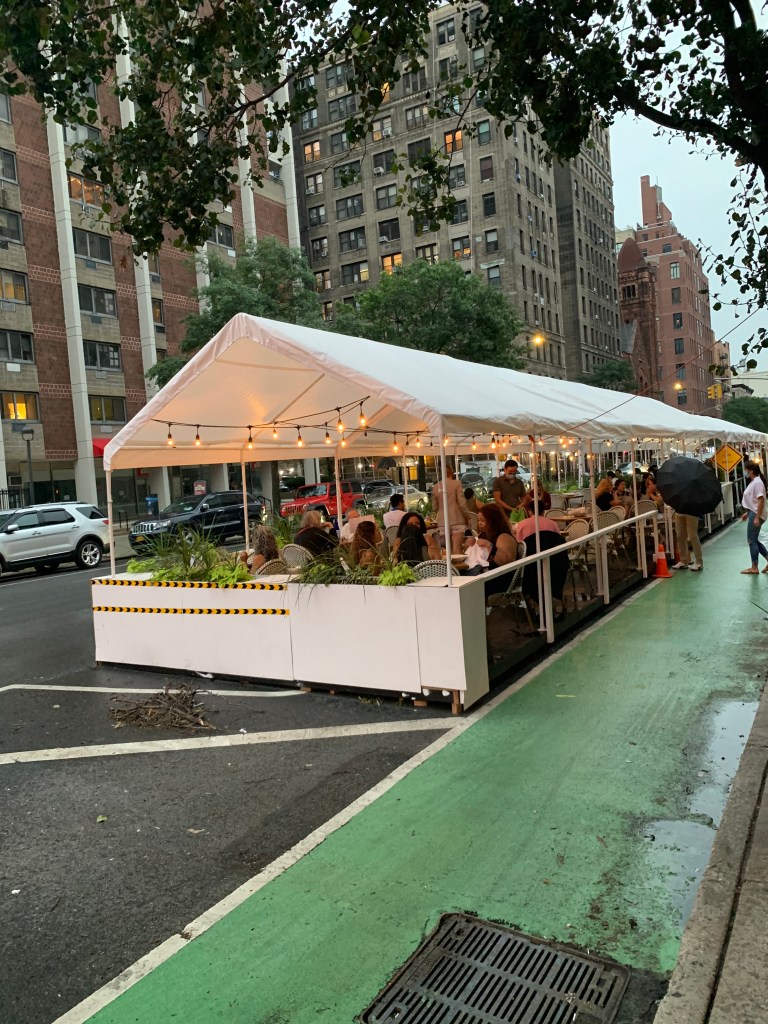
The trend is not limited to New York. Philadelphia, Chicago, San Francisco, and other major eating hubs have taken a similar approach – testing street closures to let restaurants move outside.
Yet again, COVID has prompted a rethink of how businesses work, especially in public space. It also has prompted a rethink of how to value the streets themselves.
Many have pointed out that free street parking is a subsidy to drivers, at the expense of pedestrians and bikers. Some estimate the value of street parking in New York at $500/month.
As a public good, giving that space to restaurants – which generate tax revenue, jobs, and a vibrant street life that helps property values and safety, feels like an even better deal.
The big fight to come will be what happens at the end of the pandemic, when cars demand their streets back. Even in less car friendly locations like New York, huge portions of the City’s real estate gets devoted to automobiles.
The need for an overall redesign of how cities use their streets has been long overdue. Restaurants will join bikes, scooters, delivery trucks, EV charging stations, and transit authorities as competitors for valuable street real estate. Again, the pandemic sharpens a debate that has been brewing for a while.
But for now, dining out will help a lot of workers (and probably some New Yorkers) get through an otherwise bleak summer and fall.
 The Great Refactoring